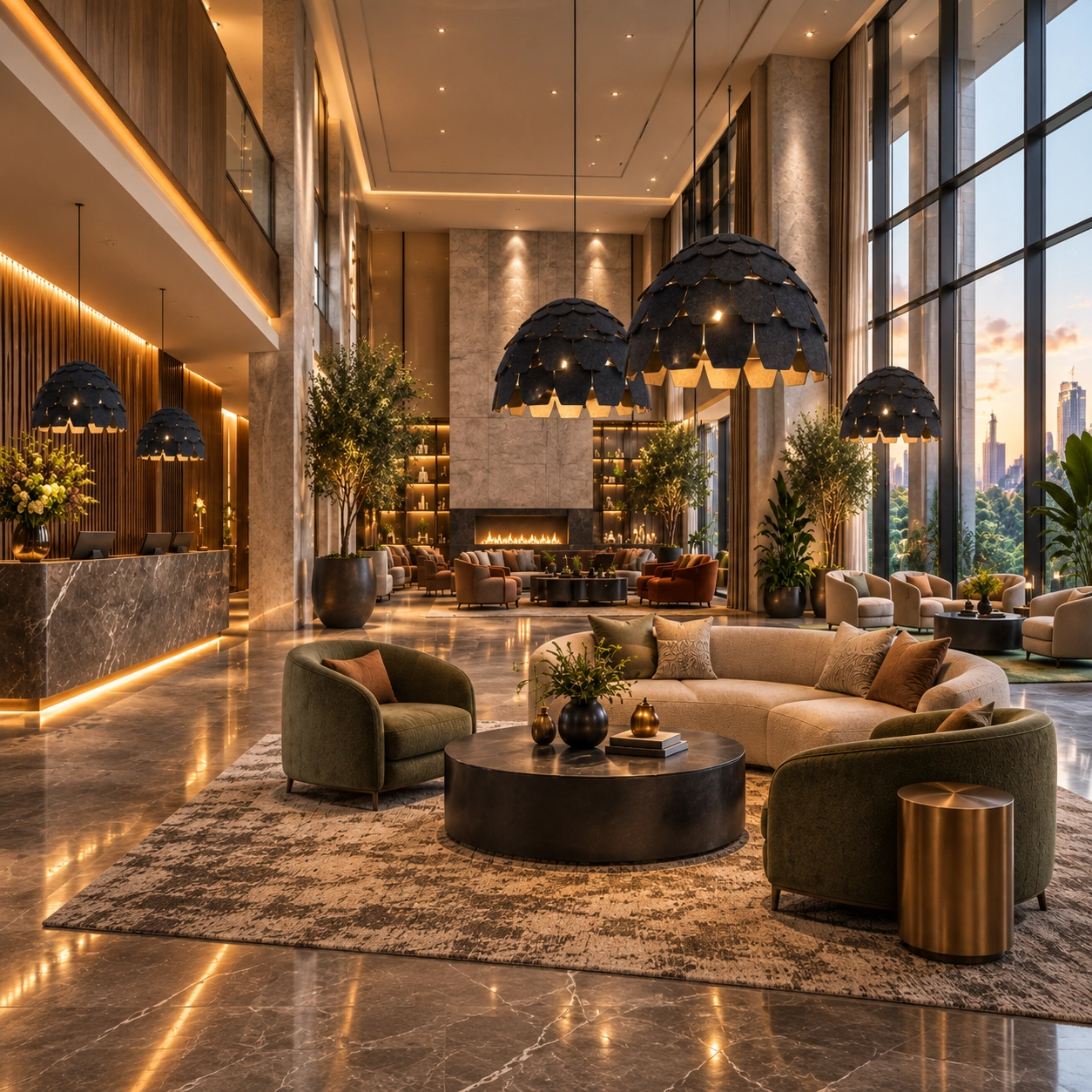

Libraries stopped being silent decades ago, but that doesn’t mean noise stopped mattering. Today’s library problem isn’t too much sound — it’s the wrong sound in the wrong zone: a group project table’s conversation bleeding into a quiet study corner, HVAC hum competing with focused reading, or footsteps and chair scrapes reflecting off hard ceilings into every corner of the floor.
This article looks at what research actually says about noise and concentration in library and study environments, why zoning is the foundation of good library acoustics, and how acoustic lighting helps deliver both the comfortable illumination and the sound absorption that focused study spaces need.
What the Research Says About Noise and Focus
The case for treating library acoustics seriously isn’t anecdotal. Research on cognitive task performance consistently finds that noise is detrimental to concentration, increases stress and fatigue, and measurably affects both health and learning outcomes [web:63]. That’s a stronger claim than “noise is annoying” — it’s a documented link between ambient sound conditions and how well people can actually think.
Library-specific research adds an important nuance: people don’t expect uniform acoustic conditions across an entire library floor. Studies on ambient sound in library study areas found that visitors evaluate acoustic quality differently depending on what a given zone is designated for — areas marked for “reading and thinking” are held to a noticeably higher acoustic standard than general circulation or group spaces, and users notice quickly when that expectation isn’t met [web:60][web:61].
This is the central design challenge for any library or study space: background noise and speech intelligibility pull against each other. Raising background noise to mask disruptive sounds reduces intelligibility and comfort in areas where people are actively collaborating, while areas meant purely for concentration need the opposite — noise suppressed as much as possible, not masked [web:62]. A single acoustic strategy applied uniformly across the whole floor plan satisfies neither need well.
Zoning: The Foundation of Library Acoustic Design
Acoustics researchers studying contemporary library design are direct about the solution: only a rigorous design of distribution layouts can properly map spaces with different noise levels, separating the areas that generate noise from the areas that need to be protected from it [web:62]. In practice, that means a library floor plan should be read acoustically in distinct zones, not as one open space:
-
Quiet/focused study zones — the areas held to the strictest acoustic expectations, where users expect near-silence and notice deviations quickly [web:61].
-
Collaborative/group work zones — areas that can tolerate more conversation and activity noise without needing the same suppression as quiet zones [web:62].
-
Circulation and service zones — transitional areas where noise from footsteps, checkouts, and movement should be contained before it spreads into either of the zones above.
The University of Birmingham Library case study on acoustic comfort identifies three concrete requirements that support this zoning approach: an acceptable background noise level, physical separation between noise-producing and noise-sensitive areas, and sound-absorbing material dispersed throughout the space rather than concentrated in just one location [web:71]. Physical separation (walls, shelving, distance) handles part of the problem, but the ceiling above each zone still needs to do its share of the absorption work — and that’s where lighting choices become an acoustic decision, not just a visual one.
Where Acoustic Lighting Fits Into a Library Floor Plan
Library and study space lighting has its own set of requirements — even, comfortable illumination for reading without glare or flicker, appropriate warmth for long study sessions, and enough brightness for close visual tasks. Acoustic lighting — fixtures combining LED illumination with an integrated sound-absorbing core — lets a library meet those lighting requirements zone by zone while simultaneously providing the ceiling-level absorption that quiet study areas specifically need [web:74].
This is particularly useful in libraries because ceiling treatment has to be distributed intelligently rather than applied as a blanket layer across the entire floor, matching the “dispersed throughout the space” principle from acoustic comfort research [web:71]. Acoustic lighting makes that distribution practical: higher-absorption fixtures over quiet study zones, standard comfortable lighting with lighter acoustic treatment over circulation areas, and a deliberate transition in fixture density at the boundary between zones.
Practical placement guidance by zone
-
Quiet study areas: Prioritize higher-NRC acoustic lighting directly overhead, and keep these zones physically distanced from noisier areas such as bathrooms, mechanical rooms, and common spaces, consistent with quiet library design guidance [web:74].
-
Group work and collaborative tables: Use acoustic lighting to absorb the elevated conversational noise these zones naturally generate, preventing it from reflecting into adjacent quiet zones rather than trying to eliminate the conversation itself [web:62].
-
Transition corridors and circulation paths: Maintain moderate acoustic treatment to contain footstep and movement noise before it reaches either a quiet or collaborative zone.
-
Reading nooks and individual study pods: Combine warm, glare-free acoustic lighting with the tightest sound absorption in the building, since these are the spaces where users have the highest acoustic expectations and notice failures fastest [web:61].
Designing for the Way People Actually Use Libraries
Modern library use has shifted from a single quiet reading hall to a mix of collaborative learning commons and focused study zones existing side by side, and the acoustic design has to keep pace with that shift rather than defaulting to one-size-fits-all treatment [web:63]. Sound masking strategies, physical zoning, and absorptive ceiling treatment are all part of the toolkit acoustics researchers point to for managing this mix [web:64].
Acoustic lighting supports this by putting sound absorption exactly where the lighting plan already needs to go — meaning a library can zone its acoustic performance without needing a separate acoustic-panel layout fighting for the same ceiling space as the light fixtures. The result is a floor plan where the reading corner actually feels calm, the group table doesn’t disturb the students two rows over, and the lighting supporting both zones never has to compromise to make the acoustics work.