
A hotel lobby has to do more acoustic work than almost any other commercial space in a building. It absorbs check-in conversations, rolling luggage, elevator chimes, bar chatter, and lounge socializing — often all at the same time, under a soaring ceiling that was designed to impress rather than to behave acoustically. The result, in far too many hotels, is a grand entrance that looks stunning in photos and sounds exhausting after ten minutes inside it.
This article looks at how hospitality acoustics experts recommend treating lobbies and lounges, why the ceiling and its statement lighting are the natural place to solve the problem, and how acoustic lighting lets a hotel keep its visual centerpiece while quietly fixing the reverberation underneath it.
Why Hotel Lobbies Are an Acoustic Worst Case
Lobbies combine nearly every acoustic liability at once: hard flooring for durability and cleanability, large glass frontages, soaring double- or triple-height ceilings for architectural drama, and open sightlines connecting check-in, seating, and bar areas with no walls to contain sound between them. Hospitality acoustics guidance describes this directly — think acoustics first, not last, because a lobby’s soundscape has to account for check-in conversations, ringing telephones, elevator bells, and general bar and lounge chatter, all bouncing through the same open volume [web:86].
Sound-first hospitality frameworks used by hotel and bar consultants recommend mapping a venue’s actual soundscape before treating it — walking the space at both peak and quiet times, and documenting what dominates: HVAC hiss, lobby chatter, elevator chimes, or bass bleed from a bar sound system [web:87]. That mapping consistently identifies the lobby and the busiest dining or bar area as the two zones needing the most attention, precisely because they combine the highest occupancy with the largest amount of untreated reflective surface [web:87].
The Ceiling Is Where Hospitality Acoustics Experts Start
Nearly every professional checklist for hotel lobby acoustics puts the ceiling first, not last, in the list of fixes. Kirei’s hotel lobby acoustics checklist recommends breaking up large, flat ceiling expanses with coffered designs, baffles, “wings,” or curved sections specifically because an unbroken flat ceiling over a large lobby volume is one of the most consistent sources of excessive reverberation [web:86]. Where a flat ceiling can’t be avoided, the same guidance calls for installing absorptive panels directly onto it, and recommends sound-absorbing panel coverage across at least 10 to 20 percent of the total ceiling and wall area to make a measurable difference [web:86].
Sound-first hospitality guidance echoes the same priority with a specific visual note: instead of blanketing every wall with acoustic panels, focus on high-impact, guest-visible improvements like ceiling baffles or clouds above dining tables and bars, since these interventions do real acoustic work while also becoming part of the space’s design language rather than hiding as pure infrastructure [web:87]. That combination — acoustic function that also reads as intentional design — is exactly the opening for a statement lighting fixture to do double duty.
Statement Lighting as an Acoustic Focal Point
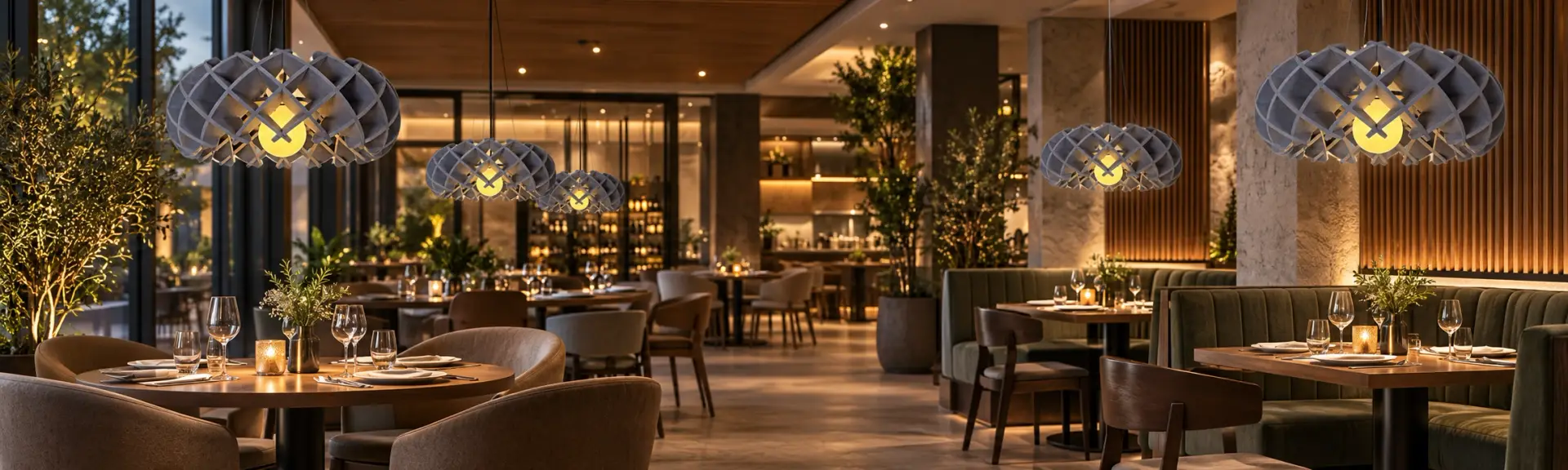
Most hotel lobbies already build their identity around one dramatic lighting element — a sculptural chandelier, a suspended ceiling installation, a cluster of pendant fixtures over the check-in desk or lounge seating. Acoustic lighting lets that same visual centerpiece carry genuine sound-absorbing material, typically PET felt, acoustic foam, or engineered fiber cores integrated into or behind the fixture’s visible form, rather than treating the ceiling’s acoustic performance and its visual drama as two separate, competing budgets.
This approach lines up directly with hospitality acoustics recommendations to concentrate sound control efforts in the specific areas where they’re needed most — lowering or treating the ceiling over the reservation desk and check-in counter, and creating a calmer “oasis” feel in lounge seating through wrapped or absorptive surfaces overhead [web:86]. A large-format acoustic lighting installation suspended over the lounge or check-in zone can serve as exactly this kind of concentrated treatment: visually anchoring the space while absorbing the reflected sound that would otherwise bounce between the hard floor, glass frontage, and open ceiling above it.
Where to concentrate acoustic lighting in a lobby or lounge
-
Over the check-in and reservation desk, where hospitality guidance specifically recommends treating the ceiling to protect the privacy and clarity of guest conversations at the counter [web:86].
-
Above lounge seating clusters, creating the “conversation pocket” effect sound-first hospitality design recommends — a mid-volume zone balanced for comfortable conversation, distinct from higher-energy areas near a bar [web:87].
-
Directly above or around any large open-plan bar area within the lobby footprint, since bar zones are consistently identified as one of the loudest sub-areas within a broader lobby or lounge space [web:87][web:86].
-
Along the transition zones between the lobby’s open volume and adjacent corridors, helping contain lobby noise bleed before it reaches guest room floors — an issue sound-first hospitality audits flag as a recurring top complaint [web:87].
Combining Function and First Impressions
A hotel lobby’s lighting is often the first thing a guest notices and photographs; its acoustics are what determines whether that same guest feels comfortable enough to sit down and stay a while. Treating those as one coordinated design decision, rather than lighting chosen by the design team and acoustics patched in afterward, is what separates a lobby that looks impressive from one that also performs.
Acoustic lighting gives hospitality designers a genuine way to combine those goals: a statement fixture that anchors the guest’s first impression of the space, built with the sound-absorbing core that keeps the check-in desk, lounge seating, and bar area from turning that same striking architecture into a source of guest fatigue.