
A café that’s too quiet feels dead. A café that’s too loud drives people to hold their phone up to their ear just to hear the person across the table. The best-performing social spaces sit in a narrow, specific zone between those two failure modes — and getting there is an acoustic design problem, not just a vibe.
This article explains what research on café acoustics actually shows about the relationship between background noise, music, and comfort, and how acoustic lighting helps cafés and social spaces hit that balance instead of drifting toward one extreme or the other.
The Research Behind “Good Café Noise”
Café atmosphere and acoustic comfort aren’t opposing goals — but they interact in ways that are easy to get wrong. A field study conducted in an actual café measured acoustic comfort across a multi-group conversation space and found that overall, guests rated the café space positively, but high background music volume combined with fully occupied neighboring tables consistently produced negative evaluations of comfort [web:75]. In other words, the atmosphere itself wasn’t the problem — the combination of loud music and an already-busy room pushed total sound levels past what guests found comfortable.
The same study identified something specific for café operators: guests’ comfort ratings were also shaped by their distance from loudspeakers and by whether neighboring tables were occupied, meaning acoustic comfort in a café is partly about layout and speaker placement, not just overall volume [web:75]. A café that sounds fine near the window might feel oppressive at the table next to the speaker — even though the average decibel reading for the room looks identical.
Industry guidance backs this up with a practical number: cafés generally aim to keep ambient sound in the 60 to 70 decibel range, whether that sound comes from music or general activity, because that band supports a lively feel without pushing into the territory where conversation becomes difficult [web:78]. The goal isn’t silence — it’s staying inside a range where people can talk normally without raising their voice.
Why Cafés Are Acoustically Harder Than They Look
Cafés tend to combine several acoustic liabilities in one space: hard tile floors, large glass windows, minimal soft furnishing, and often high or exposed ceilings — all surfaces that reflect sound rather than absorb it [web:79]. Acoustic design guidance for cafés recommends a target reverberation time of roughly 0.5 to 1.0 seconds [web:82], but many cafés, especially those designed for a minimalist or industrial aesthetic, run well above that simply because so few surfaces in the room are doing any absorption work.
This creates the specific problem café operators recognize immediately: small, hard-surfaced cafés get fatiguing fast, not because the noise level itself is extreme, but because reflected sound compounds throughout service, making the space feel progressively louder and more tiring the longer guests stay [web:85]. A café that feels pleasant at 10 a.m. can feel genuinely stressful by the lunch rush, even though the number of customers hasn’t changed dramatically — the accumulated reflected sound has.
Zoning: Letting Different Areas Serve Different Purposes
The most effective café acoustic strategies don’t try to make the whole room uniformly quiet or uniformly lively — they zone the space so different areas can serve different social needs. Café design guidance recommends creating separate zones, such as quieter areas suited to working or reading and louder areas suited to socializing, using partitions, plants, or furniture arrangement to help contain louder conversation to the zones built for it [web:79][web:82].
This zoning approach also extends to isolating noise at its source: placing coffee prep areas, espresso machines, and dishwashing stations away from the center of the café and physically separated from seating, since equipment noise is one of the most persistent contributors to overall café sound levels [web:79][web:82].
Where Acoustic Lighting Supports the Balance
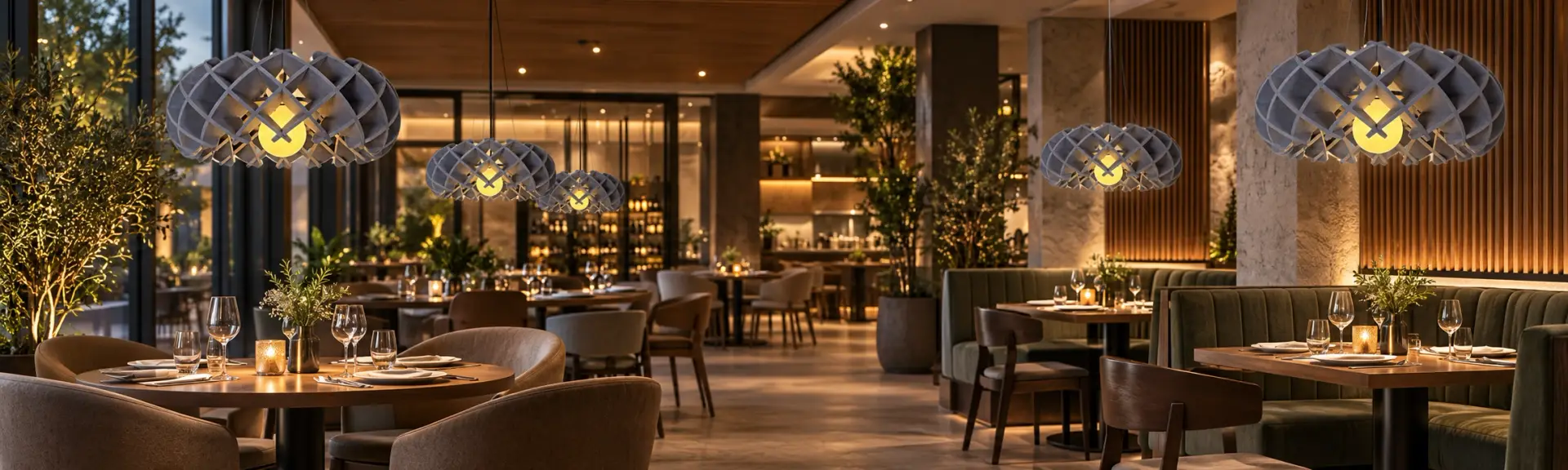
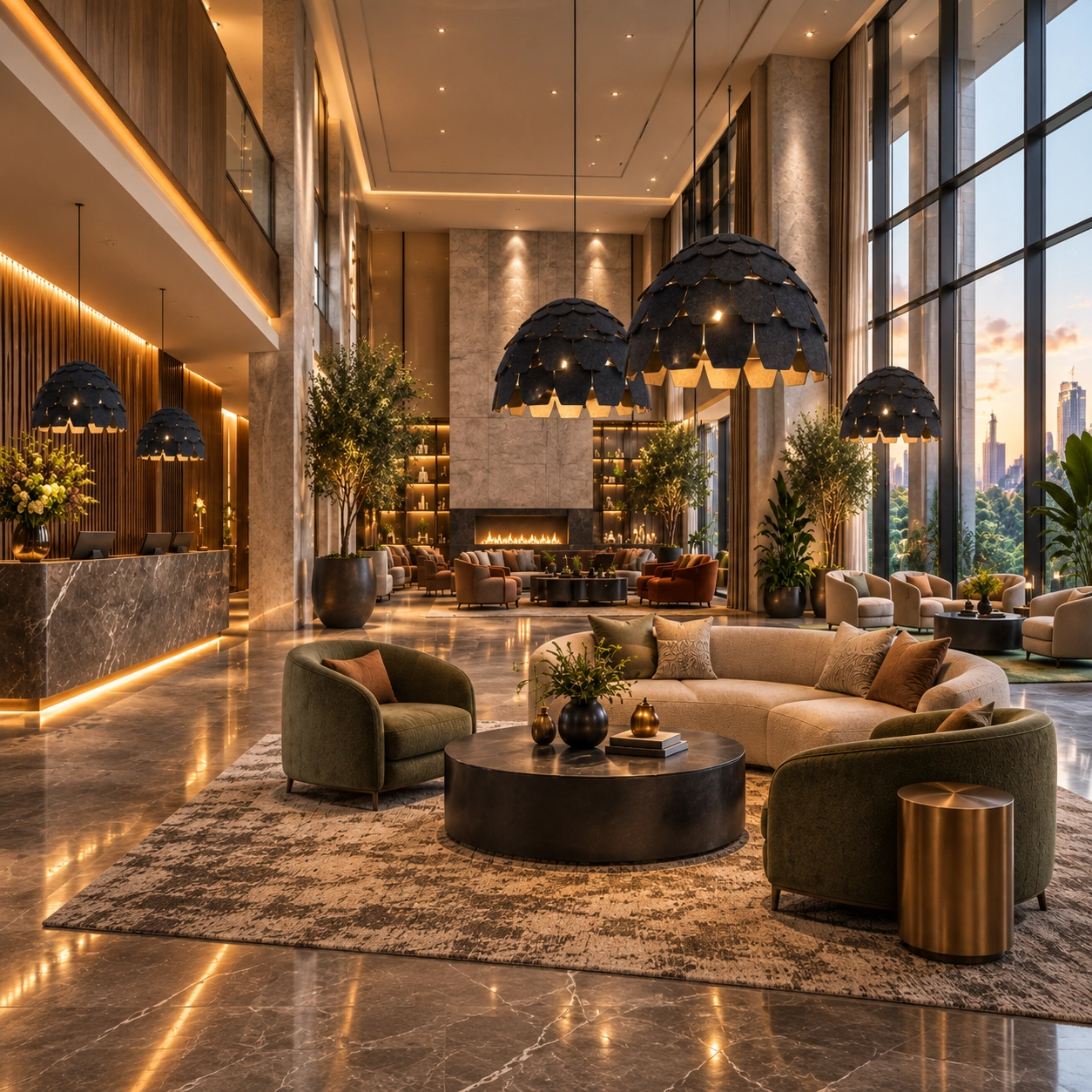
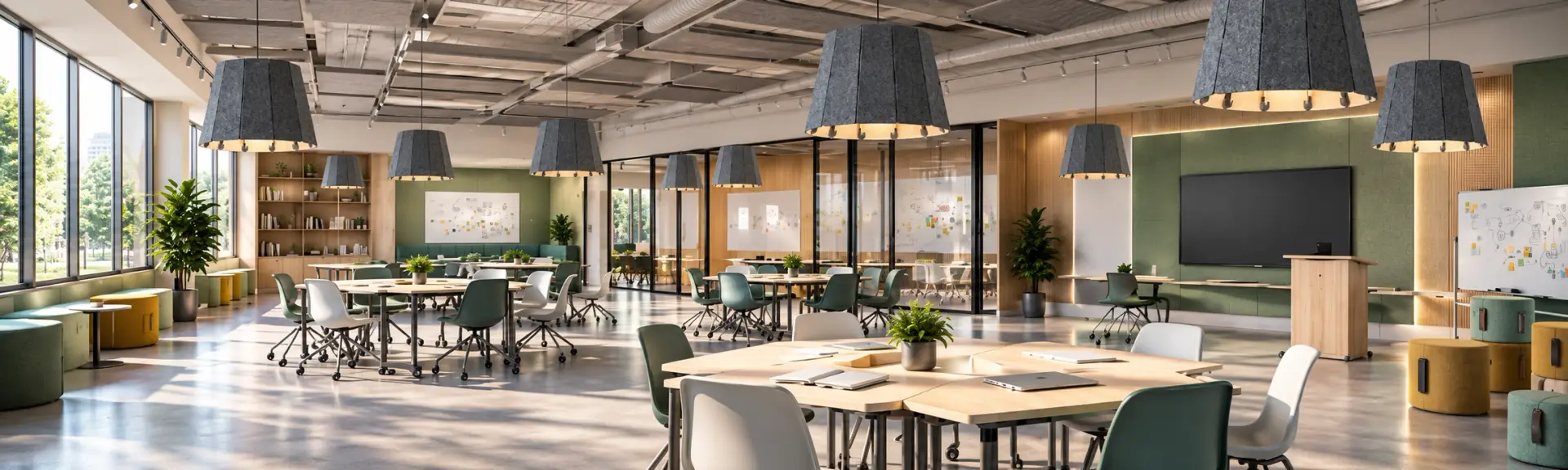
Acoustic lighting — fixtures combining LED illumination with a sound-absorbing core — gives café designers a way to add ceiling-level absorption without abandoning the exposed, characterful lighting that shapes a café’s visual identity. Since ceiling treatment is one of the primary levers for reducing reflected sound in high-ceilinged, hard-surfaced spaces [web:79], integrating that treatment into the lighting fixtures themselves means the café doesn’t need to choose between a good-looking ceiling and an acoustically comfortable one.
Applied with the zoning principles above, acoustic lighting placement can reinforce a café’s social layout rather than just adding uniform treatment:
-
Position higher-absorption acoustic lighting over communal or high-turnover seating areas, where multiple conversations are likely to overlap and generate the most reflected sound [web:75].
-
Use lighter, more decorative acoustic lighting in quieter corners intended for solo work or reading, supporting the “control the noise flow” principle of keeping quieter zones actually quieter [web:79].
-
Keep acoustic lighting fixtures away from directly clustering around speaker placements only — since guest comfort was shown to depend on speaker proximity specifically, treatment should address both music-driven and conversation-driven reflected sound [web:75].
-
Combine ceiling-level acoustic lighting with soft furnishings — upholstered seating, curtains, rugs — since hard-surfaced cafés typically need treatment across multiple surfaces, not the ceiling alone, to meaningfully shift reverberation time [web:79][web:82].
Keeping the Buzz Without the Burnout
A great café sound isn’t the absence of noise — it’s the presence of energy without exhaustion. The research is fairly consistent: guests enjoy a lively, socially active café, but that enjoyment collapses quickly once background music and occupancy noise stack past a comfortable threshold [web:75][web:78].
Acoustic lighting gives café and social space designers a tool that supports both halves of that equation at once — contributing real ceiling-level sound absorption while still delivering the layered, characterful lighting a social space needs to feel inviting. Done well, it’s the difference between a café that customers linger in and one they quietly start avoiding during the busiest hours.