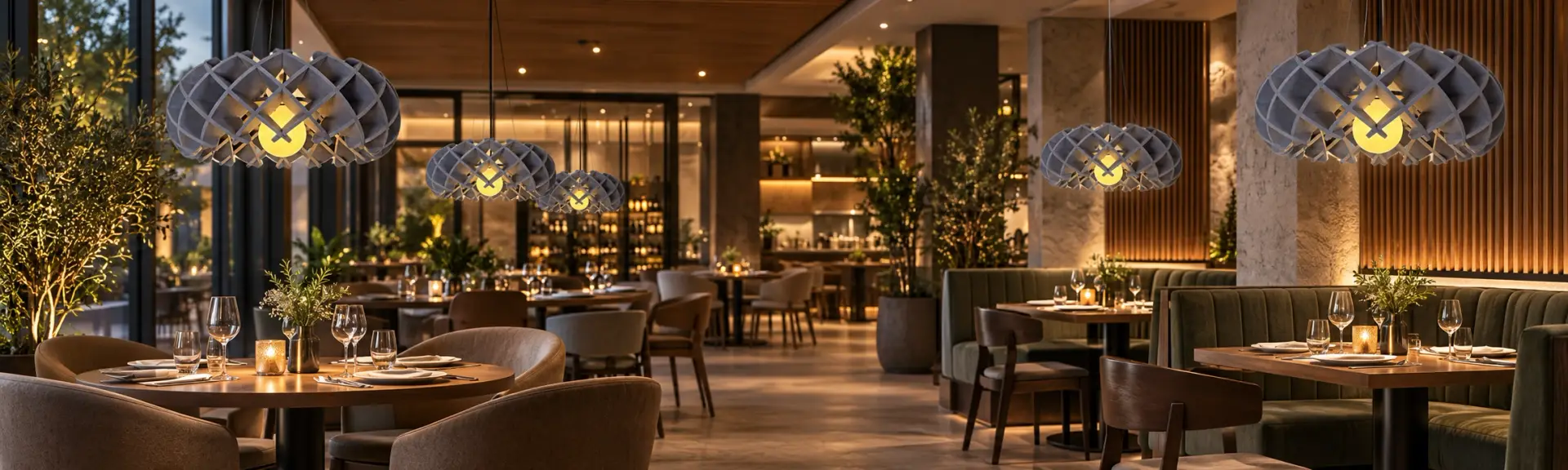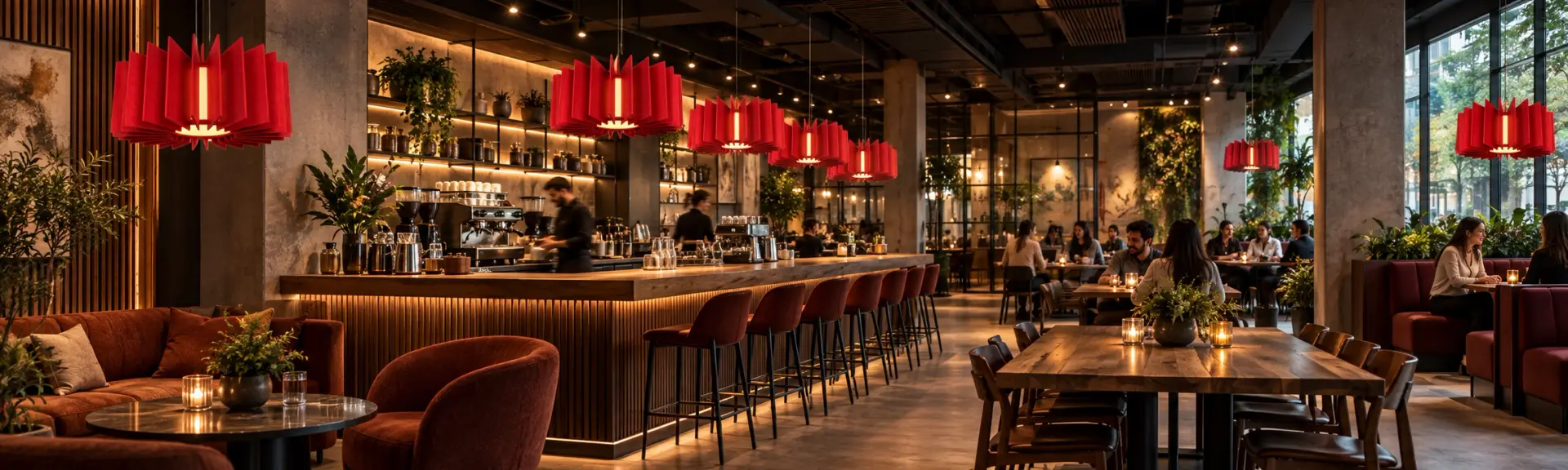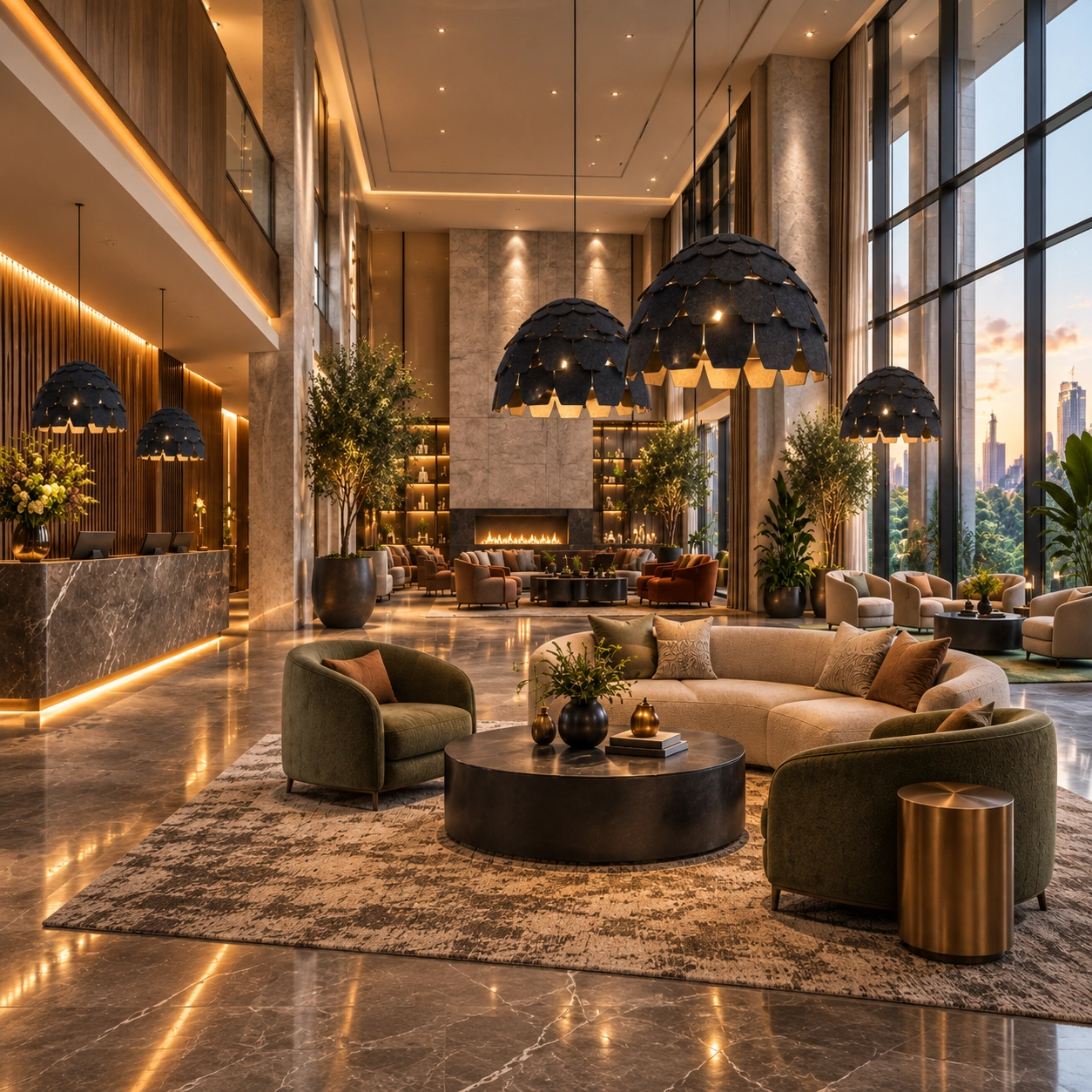

Acoustic lighting is a type of lighting fixture that combines functional illumination with sound-absorbing materials in a single product.
Instead of treating lighting and room acoustics as two completely separate systems, acoustic lighting uses materials such as PET felt around or alongside the light source. These surfaces help absorb part of the sound energy that would otherwise reflect from hard ceilings, walls and other surfaces.
The result is not a fixture that “cancels noise.” Its role is different: acoustic lighting adds sound-absorbing surface area to a room while providing the illumination the space already needs.
This makes it particularly useful in offices, meeting rooms, hospitality environments and other commercial interiors where lighting, acoustics and ceiling space all need to be considered together.
Why Do Commercial Spaces Need Acoustic Treatment?
Many modern interiors use materials such as glass, concrete, plasterboard, metal and hard flooring.
These materials are visually clean and durable, but they also reflect a large amount of sound.
When people speak, move chairs, use phones or work in the same space, sound travels outward and reaches these surfaces. Instead of being absorbed immediately, some of that sound is reflected back into the room.
Multiple reflections can remain in the space after the original sound is produced. This is known as reverberation.
Excessive reverberation can make a room feel louder and can cause different sounds to overlap. In spaces where communication is important, it may also make speech more difficult to understand.
Traditional acoustic treatment normally introduces additional sound-absorbing materials through ceilings, wall panels, suspended baffles or other acoustic elements.
Acoustic lighting takes another approach.
It turns part of the lighting system itself into an additional acoustic surface.
How Does Acoustic Lighting Work?
An acoustic light normally combines two separate functions:
Lighting performance
The integrated light source provides the illumination required for the space, including factors such as light output, color temperature, color rendering, beam distribution and glare control.
Sound absorption
Porous acoustic material around the fixture absorbs part of the sound energy that reaches its surface rather than reflecting all of it back into the room.
These two functions work together within one architectural element.
A suspended acoustic light, for example, may illuminate the desks or meeting table below while its felt surfaces interact with sound traveling through the surrounding space.
This does not mean that one acoustic light will solve every acoustic problem.
The overall result depends on several factors, including:
- the amount of acoustic material
- the shape and orientation of the fixture
- the number of fixtures
- suspension height
- placement within the room
- room volume
- existing ceiling and wall finishes
- other acoustic treatment already present
For this reason, acoustic lighting should be considered as part of the overall room design rather than simply as a decorative lamp with felt attached to it.
What Materials Are Used in Acoustic Lighting?
PET felt is one of the most commonly used materials in modern acoustic lighting.
PET, or polyethylene terephthalate, can be processed into a lightweight porous felt that can be cut, folded and formed into different shapes.
This makes it particularly suitable for lighting products because the acoustic element can become part of the visual design rather than appearing as a separate technical panel.
Depending on the design, PET felt can form:
- vertical baffles
- horizontal panels
- circular rings
- decorative shades
- linear fins
- suspended clouds
- sculptural forms
The amount of exposed acoustic material matters.
A fixture with a small decorative felt component does not necessarily provide the same acoustic contribution as a larger fixture with significantly more exposed absorbing surface.
When comparing products, therefore, it is useful to look beyond the material name alone.
What Is NRC in Acoustic Lighting?
NRC stands for Noise Reduction Coefficient.
It is commonly used to describe the sound absorption performance of acoustic materials across a range of frequencies.
However, buyers should be careful when comparing NRC figures for acoustic lighting.
An NRC value may refer to the PET felt material itself or to a particular tested assembly. The complete lighting fixture may have a different geometry, exposed surface area and installation condition.
For project specification, it is therefore better to ask:
- What exactly was tested?
- Was the rating for the raw material or the complete assembly?
- What test method was used?
- What is the thickness of the acoustic material?
- How much absorbing surface does the fixture provide?
The acoustic performance of a complete room cannot be determined from a single material rating alone.
What Are the Main Types of Acoustic Lighting?
Acoustic lighting is available in several formats. The best choice depends on the lighting task, acoustic requirements and architectural layout.
Acoustic Pendant Lights
Acoustic pendant lights combine suspended lighting with surrounding sound-absorbing material.
They work particularly well above:
- meeting tables
- desks
- collaborative areas
- reception areas
- dining tables
- informal seating zones
Because the fixture is suspended below the ceiling, acoustic surfaces can often be exposed on multiple sides.
Pendant designs also offer considerable freedom in form, making them suitable when the lighting needs to become a visible part of the interior design.
Acoustic Linear Lights
Acoustic linear lights are useful where the lighting layout follows desks, tables, circulation routes or architectural lines.
They can be installed individually, in repeated rows or as longer continuous arrangements.
This format is particularly relevant to offices and workspaces because the same ceiling layout can provide task-oriented illumination while adding acoustic material above occupied areas.
Acoustic Ceiling and Panel Lights
Acoustic ceiling and panel lights combine a broader sound-absorbing surface with integrated lighting.
Compared with smaller decorative pendants, panel-based formats can introduce more acoustic material into the ceiling area.
They are useful where designers want the lighting and acoustic treatment to read as one larger architectural element.
Sculptural Acoustic Lights
Not every commercial space requires the lighting to disappear into the ceiling.
Reception areas, hotel lobbies, restaurants and other public spaces may require a stronger visual feature.
Sculptural acoustic lighting uses form, repetition and acoustic material to create a statement piece while retaining functional lighting and sound absorption.
Acoustic Floor and Wall Lights
Acoustic treatment does not always need to come from the ceiling.
Floor and wall-mounted acoustic lighting can be useful where ceiling installation is limited or where the interior requires additional acoustic surfaces closer to occupied areas.
These fixtures can also support layered lighting schemes by adding ambient or decorative illumination.
Where Is Acoustic Lighting Used?
Acoustic lighting is most useful in spaces where people, hard surfaces and multiple activities create repeated sound reflections.
Offices and Open-Plan Workspaces
Open offices often contain several sound sources at the same time:
- conversations
- phone calls
- online meetings
- keyboards
- equipment
- collaboration between teams
The objective is not to make an office silent.
Instead, acoustic design helps control unnecessary reflections so that sound does not continue building up throughout the room.
Acoustic lighting can be positioned above workstations, meeting areas and collaborative zones to add absorption where lighting is already required.
Meeting and Conference Rooms
Meeting rooms depend heavily on speech.
A room may have sufficient sound level while still having poor speech clarity if reflected sound overlaps with the direct voice.
Glass walls, hard tables, screens and untreated ceilings can all contribute to excessive reverberation.
Suspended acoustic lighting above the meeting table can introduce absorption close to the main conversation area while also providing the lighting required for meetings and video calls.
Restaurants and Hospitality Spaces
Restaurants, lounges and hotel public areas often need to balance several requirements:
- visual atmosphere
- comfortable lighting
- conversation
- interior design
- acoustic comfort
Adding conventional acoustic panels after the interior concept is completed can sometimes conflict with the design.
Acoustic lighting gives designers another way to introduce absorbing material through an element that already forms part of the visual scheme.
Education Spaces
Classrooms, libraries, learning areas and collaborative education spaces depend on communication.
Acoustic lighting can be integrated above tables, reading areas or group-learning zones where both illumination and acoustic treatment are useful.
What Are the Benefits of Acoustic Lighting?
The main advantage of acoustic lighting is not that it replaces two products with one in every situation.
Its advantage is integration.
1. More Sound-Absorbing Surface
The fixture adds acoustic material to areas that would otherwise be occupied only by lighting.
2. Lighting and Acoustics Can Share the Same Layout
Lighting and acoustic treatment can be planned together rather than competing independently for ceiling space.
3. Less Visual Clutter
In interiors with lighting, HVAC systems, sprinklers, sensors and other ceiling services, combining functions can help reduce the number of separate visual elements.
4. Greater Design Flexibility
PET felt can be formed into a wide range of shapes, sizes and colors, allowing the acoustic element to become part of the architectural language.
5. Useful for Both New Projects and Selected Retrofits
Acoustic lighting can be specified during the original design process, but it can also be considered when an existing commercial interior needs additional acoustic treatment and the lighting system is being upgraded.
Can Acoustic Lighting Replace Acoustic Panels?
Sometimes it can reduce the amount of separate acoustic treatment required, but it should not automatically be considered a complete replacement for acoustic panels.
The answer depends on the room.
A small meeting room with appropriate acoustic lighting and other soft surfaces may require a very different treatment strategy from a large open-plan office with a hard exposed ceiling.
The more useful question is:
How much sound absorption does this room require, and where should that absorption be located?
Once that is understood, the designer can determine how much of the requirement can be integrated into lighting and whether additional ceiling, wall or suspended acoustic elements are needed.
For larger or acoustically demanding spaces, a combination of several treatment methods is often more appropriate.
How to Choose Acoustic Lighting for a Project
Selecting acoustic lighting should begin with the room rather than the shape of the fixture.
Step 1: Define the Lighting Requirement
Consider:
- required illuminance
- direct or indirect distribution
- color temperature
- CRI
- glare requirements
- dimming and controls
- emergency lighting requirements
The acoustic function should not compromise the basic lighting task.
Step 2: Understand the Acoustic Problem
Identify what is actually happening in the space.
Is the main issue:
- excessive reverberation?
- poor speech clarity?
- sound traveling between work areas?
- insufficient absorbing surface?
- a combination of several problems?
This determines where acoustic treatment will be most useful.
Step 3: Consider the Available Acoustic Surface
Compare the amount and orientation of the exposed acoustic material rather than choosing a fixture solely because it is described as an “acoustic light.”
A larger absorbing surface can contribute differently from a small decorative felt shade.
Step 4: Match the Fixture to the Activity Below
Lighting and acoustic treatment are most effective when their placement corresponds to how the room is used.
Linear fixtures may follow office desks.
Pendant lights may sit above meeting tables.
Large acoustic panels may suit broader collaborative zones.
Sculptural fixtures may work better in reception or hospitality spaces.
Step 5: Check Installation Conditions
Before specifying the product, confirm:
- ceiling type
- suspension height
- electrical supply
- fixing points
- HVAC conflicts
- sprinklers and other services
- maintenance access
These details are especially important in retrofit projects.
Step 6: Review the Complete Specification
For commercial projects, review both the lighting and acoustic information.
Depending on the project, this can include:
- dimensions
- power
- lumen output
- CCT
- CRI
- beam angle
- dimming
- acoustic material
- acoustic test information
- fire performance
- suspension system
- color
- electrical certification
This provides a much clearer basis for product comparison than appearance alone.
Is Acoustic Lighting Right for Every Space?
No.
Acoustic lighting is most useful when a project genuinely needs both illumination and additional sound absorption.
If a space already has a highly effective acoustic ceiling and only requires decorative lighting, adding a large acoustic fixture may provide limited additional value.
Likewise, a room with a serious acoustic problem should not be treated by replacing one conventional pendant with one acoustic pendant without evaluating the wider space.
Good acoustic lighting starts with the room requirements.
The product follows the problem — not the other way around.
Acoustic Lighting as Part of Better Commercial Space Design
Modern commercial interiors are becoming increasingly multifunctional.
The same room may need to support focused work, conversation, collaboration, video meetings and social interaction, while still meeting architectural and lighting requirements.
That makes ceiling coordination increasingly important.
Acoustic lighting provides designers with another tool: instead of allocating separate ceiling areas to lighting and sound absorption, part of both functions can be integrated into the same element.
The most successful projects consider three things together:
Light. Sound. Space.
When these are planned as one system rather than three separate decisions, acoustic lighting can contribute to a cleaner ceiling, better acoustic control and a more coherent interior.
Planning an Acoustic Lighting Project?
Every space has different lighting, acoustic and installation requirements.
TUER Acoustic Lighting provides pendant, linear, ceiling and panel, sculptural, floor and wall acoustic lighting solutions for commercial interiors.
For project selection, custom sizes, colors or lighting configurations, send us your floor plan, drawings or project requirements.
Discuss Your Project →