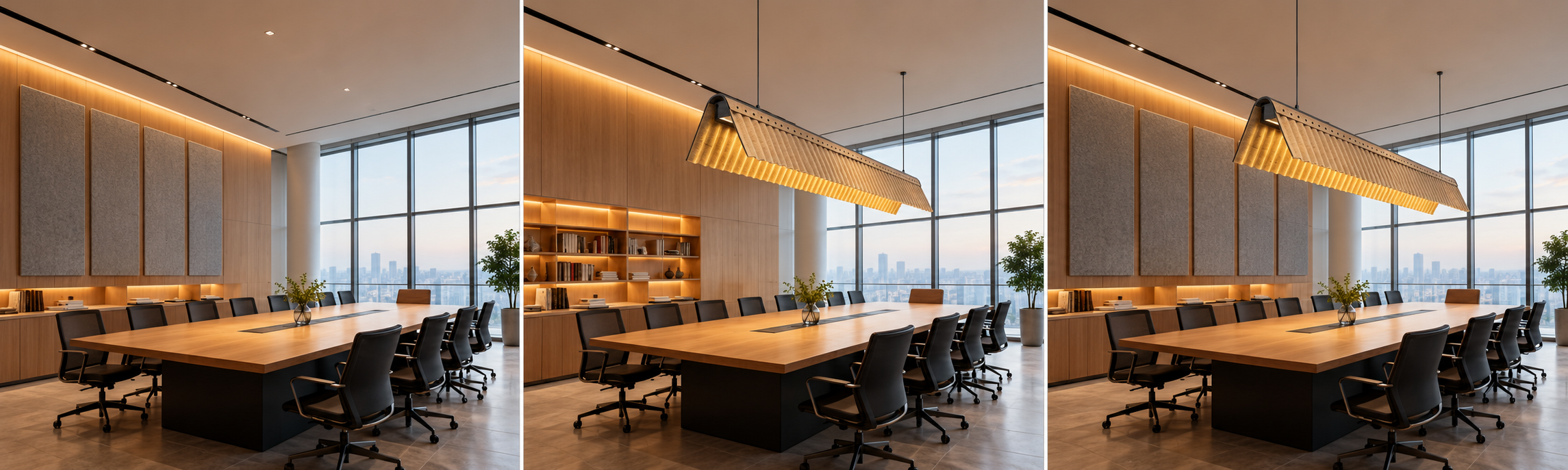

A meeting room may look excellent but still feel noisy. Voices bounce off glass walls, tables, and hard ceilings, making conversations harder to follow. In another room, speech sounds clear, yet people next door can hear the discussion.
These problems are different. One involves sound reflecting inside a room; the other involves sound passing between rooms. Knowing the difference helps architects, designers, and project teams choose the right solution.
Three common acoustic ratings—NRC, STC, and CAC—can help. But which one matters when choosing acoustic lighting?
NRC vs STC vs CAC: What’s the Difference?
| Rating | What It Measures | Main Purpose |
|---|---|---|
| NRC (Noise Reduction Coefficient) | Sound absorption | Control reflected sound inside a room |
| STC (Sound Transmission Class) | Sound insulation of building elements | Reduce sound passing through walls, doors, and other barriers |
| CAC (Ceiling Attenuation Class) | Sound transmission through a shared ceiling space | Compare the sound-blocking performance of ceiling systems |
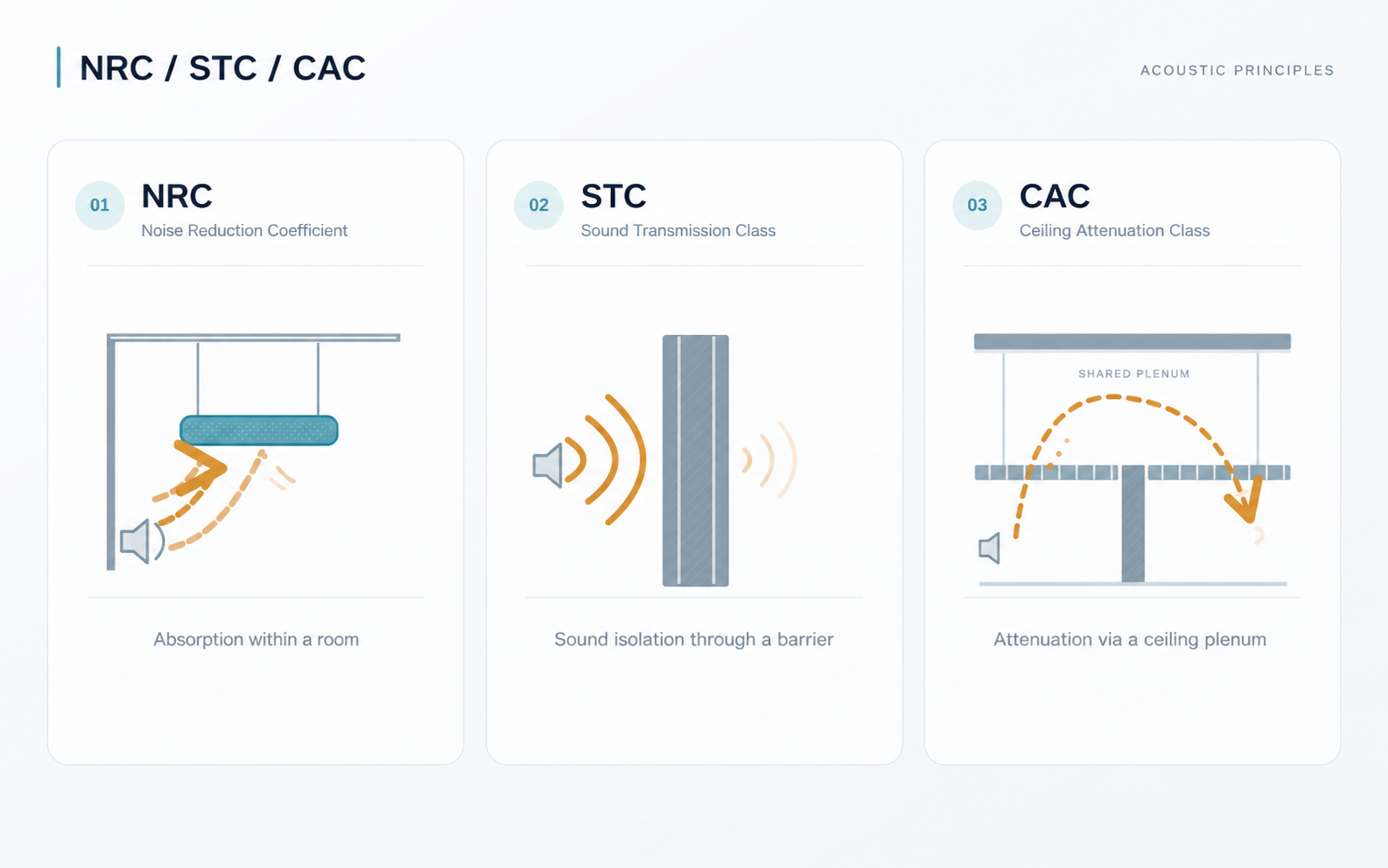
The key distinction is sound absorption versus sound insulation. A product that absorbs reflected sound does not necessarily prevent sound from reaching another room.
What Does NRC Mean for Acoustic Lighting?
NRC describes sound absorption using results from four frequency bands: 250, 500, 1,000, and 2,000 Hz. The values are averaged and rounded to the nearest 0.05.
A higher NRC generally means greater average absorption across those frequencies under the stated test conditions. However, an NRC of 0.80 does not mean a room will become 80% quieter.
Acoustic lighting often uses PET felt around or alongside a light source. The felt can absorb part of the sound that would otherwise reflect around a room. This makes acoustic lighting relevant to spaces with hard surfaces, including offices, meeting rooms, and reception areas.
But one rating cannot describe every installation. The amount and shape of exposed felt, the number of fixtures, their placement, and the room itself all matter.
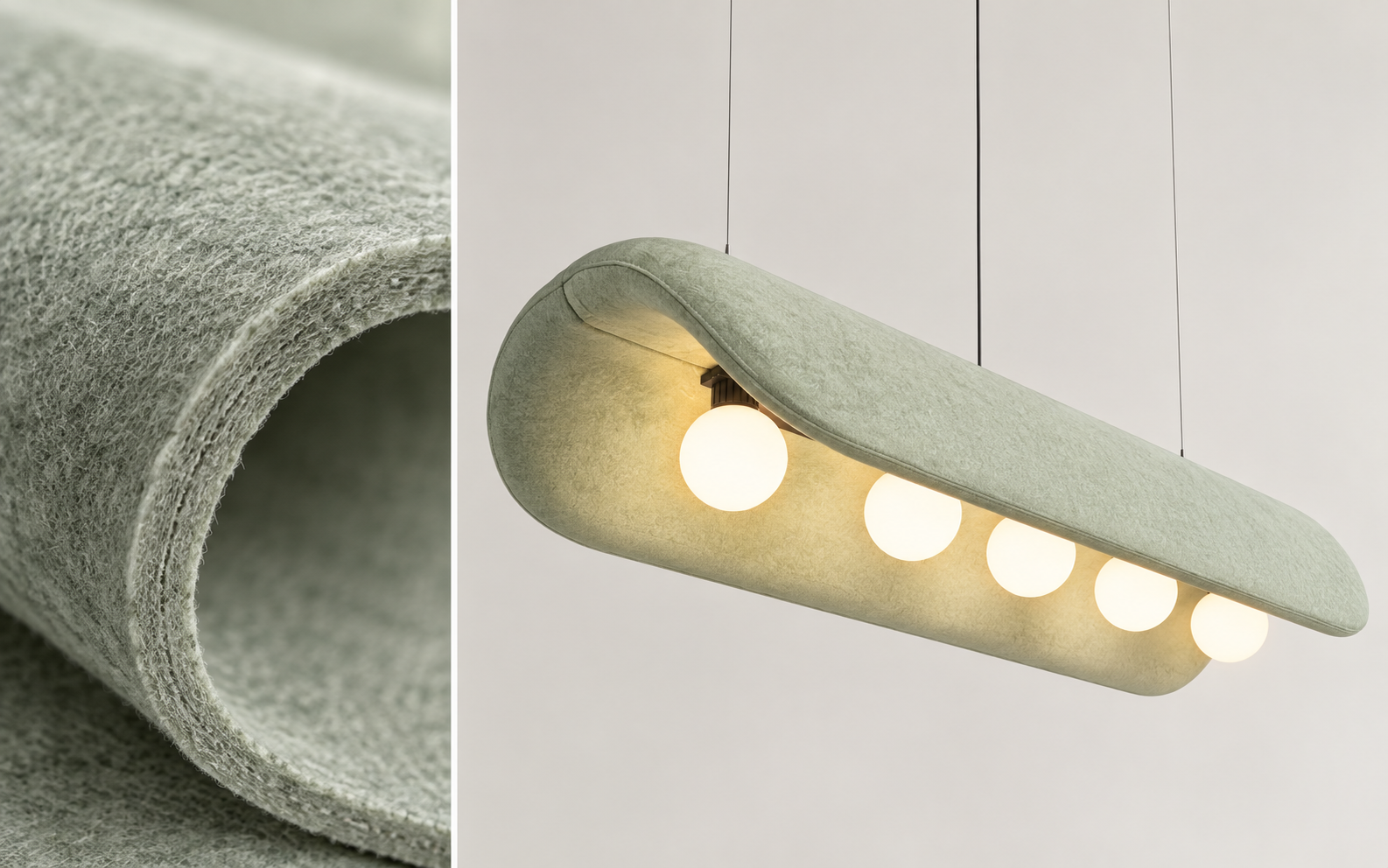
There is also an important testing difference. NRC is most useful for comparing broad surface materials. For separate hanging objects, such as some baffles and acoustic lights, a test report may give sound absorption area per unit instead. This helps a designer estimate the contribution of each fixture.
Why STC and CAC Are Different
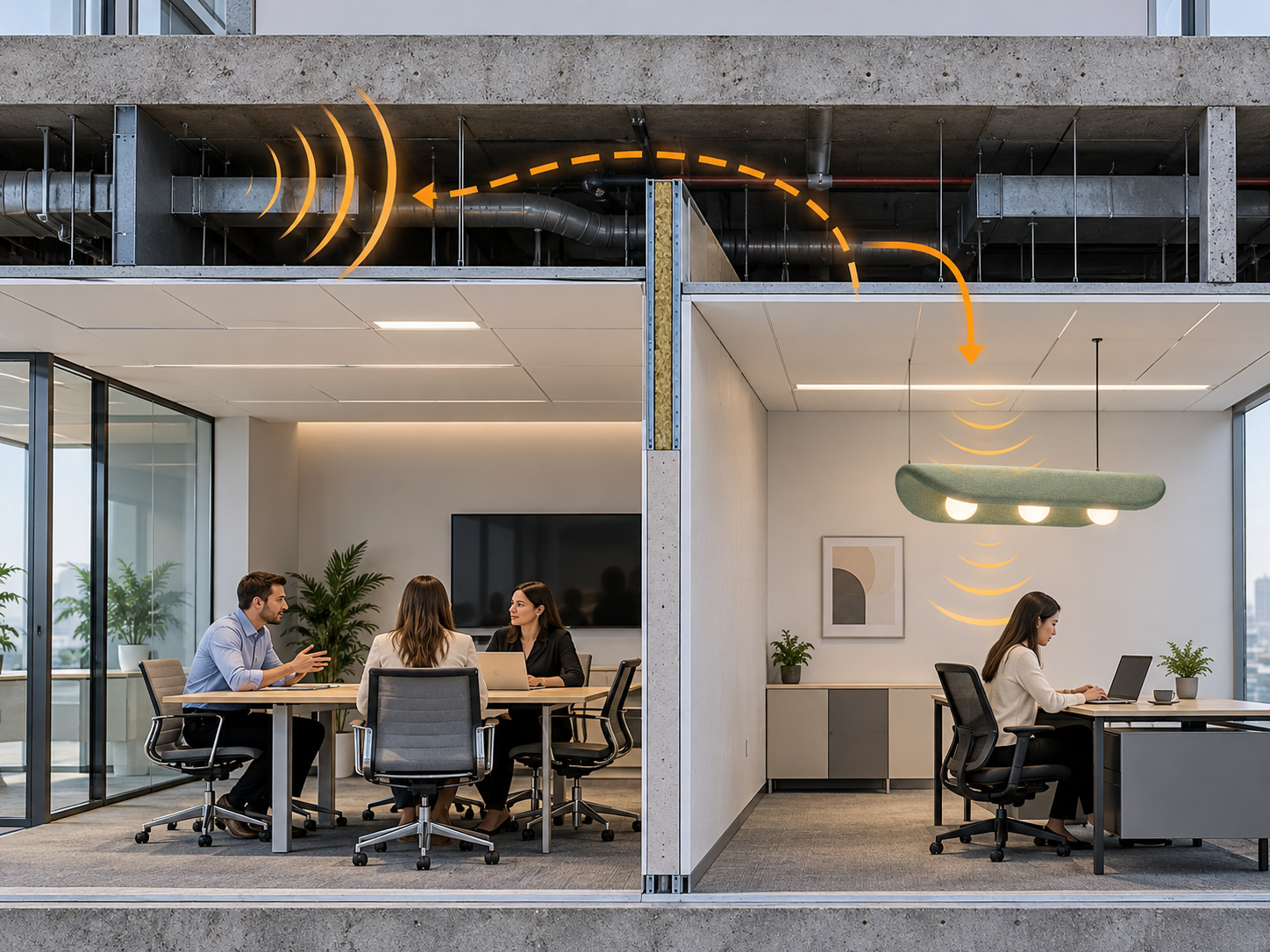
STC rates how well a tested building element, such as a wall, door, or window, limits sound transmission through the element. A higher STC generally means better sound insulation under laboratory conditions.
CAC concerns a specific route: sound travelling between neighbouring rooms through a shared space above a suspended ceiling. This matters when a dividing wall ends at the ceiling instead of reaching the structural floor above. See Intertek’s explanation of ceiling attenuation testing for this sound path.
Neither rating is a substitute for NRC. You can have a room with good sound insulation but too much echo. You can also reduce echo without stopping conversations from being heard next door.
PET felt acoustic pendant lights should not be treated as replacements for sound-insulating walls or a tested ceiling system.
Where Can Acoustic Lighting Help?
Meeting Rooms
Speech can become harder to understand when reflected sound lasts too long. Acoustic pendants or linear fixtures can add absorbing surfaces near a meeting table while supplying light.
If speech privacy is also important, review the walls, doors, and ceiling separately. For related design guidance, see how to improve speech clarity in meeting rooms.
Open-Plan Offices
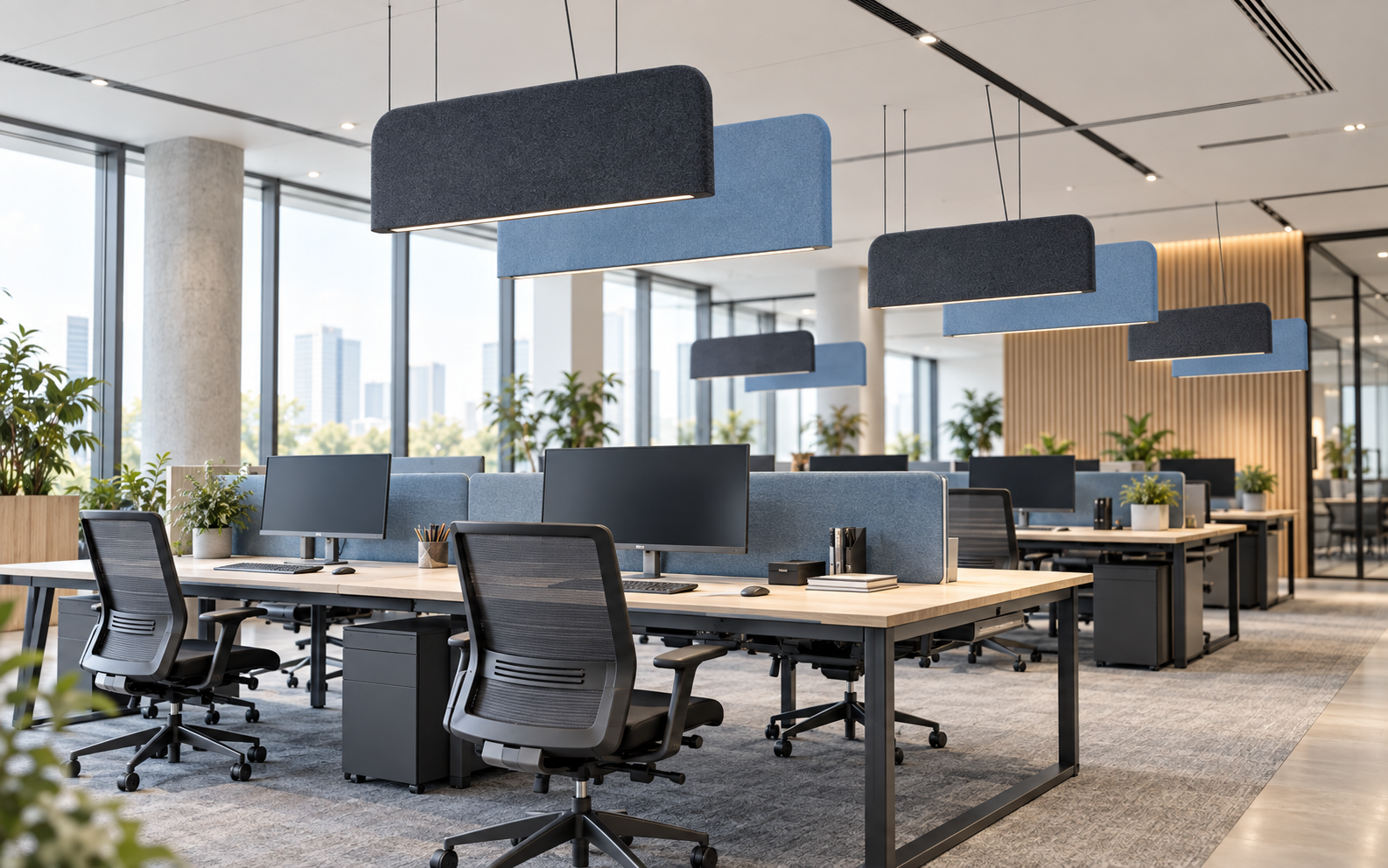
Many conversations happen at once. Acoustic lighting can be one part of a wider plan that includes ceiling or wall absorption, furniture layout, and other noise-control measures.
A few small fixtures alone may not provide enough absorption for a large office.
Reception Areas
Glass, stone, and other hard finishes can leave a space with noticeable sound reflections.
Suspended acoustic lighting can add useful absorption while supporting the lighting design. The result still depends on the size of the room and how much absorbing material is installed.
How to Check Acoustic Lighting Before You Specify It
Start with the actual problem: Is speech unclear within the room, or is sound leaking to another room?
Then check the product information:
-
What was tested? Was the result measured on flat PET felt, a complete acoustic light, or a group of hanging units?
-
Which test method was used? ASTM C423 and ISO 354 are recognised laboratory methods for measuring sound absorption.
-
What are the mounting conditions? A result from a flat sample may not describe a finished suspended luminaire.
-
Is frequency information available? A single number hides differences in absorption across frequencies.
-
How much absorption is needed? Consider the room size, existing finishes, intended use, and fixture quantity. An acoustic consultant can assess project performance targets when needed.
For projects using European specifications, also check the required ISO ratings. ISO 11654 provides a method for rating sound absorption, while ISO 717-1 covers airborne sound insulation. These ratings should not be treated as direct replacements for NRC or STC.
Use our acoustic lighting specification checklist to organise these questions.
Lighting performance matters too. Check light output, distribution, glare, suspension height, and maintenance access before finalising the layout.
Plan for Both Light and Sound
Acoustic lighting can combine useful illumination with sound absorption, but it is not a universal soundproofing solution.
NRC, STC, and CAC help answer different questions. A good specification starts by identifying the actual sound problem.
Explore our acoustic lighting range for product options and custom project requirements.
Planning an acoustic lighting project?
Send us your floor plan, ceiling layout, or lighting requirements. Our team can help you explore suitable product options and available technical documents.