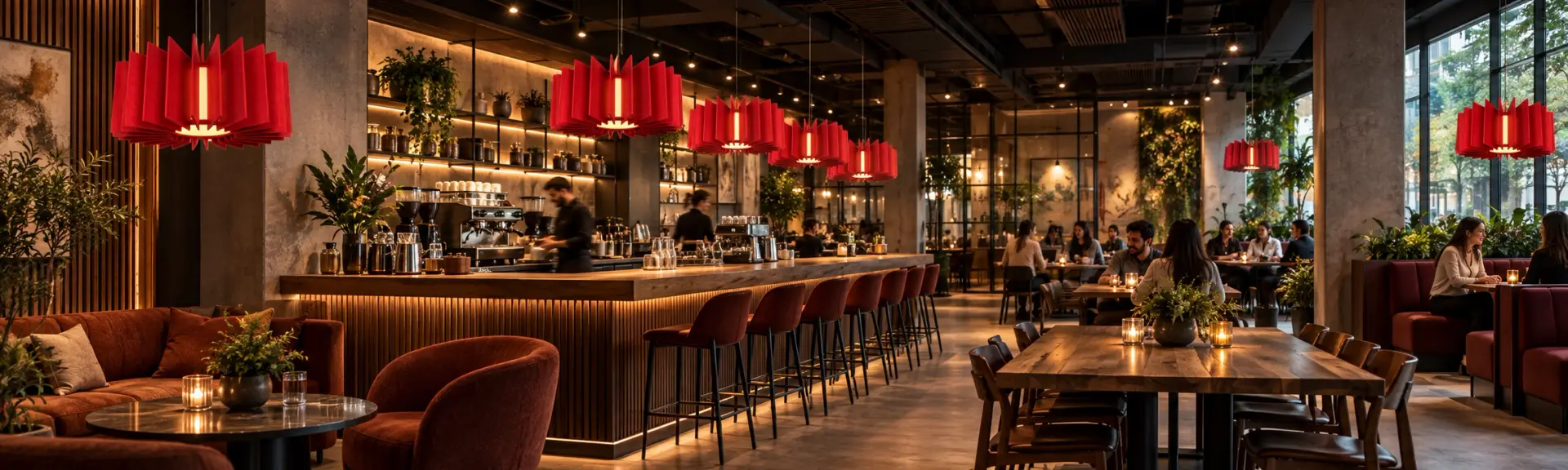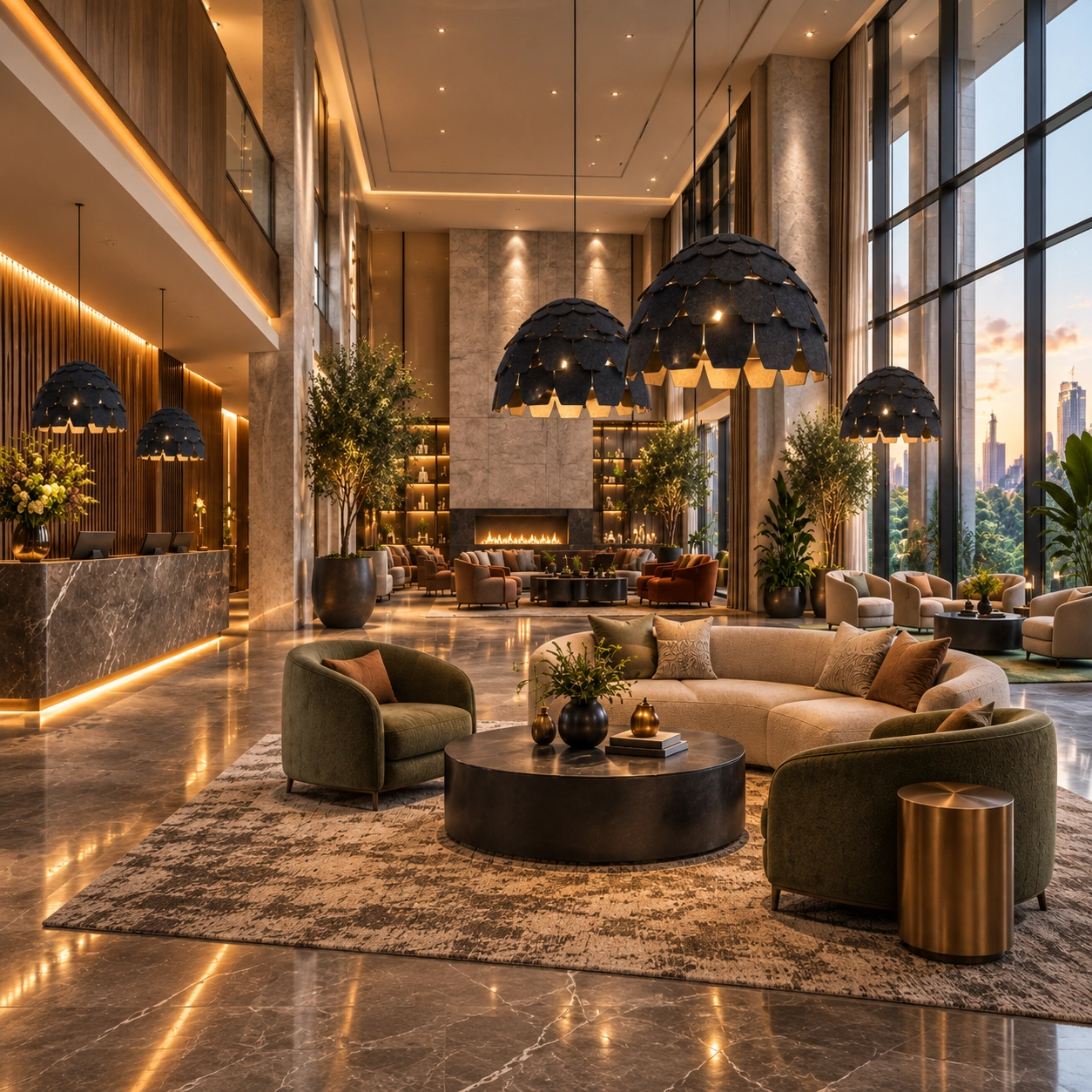

Noise beats bad food, slow service, and even parking as the top complaint diners leave in restaurant reviews. Multiple long-running surveys — from Zagat to the American Council on Science and Health — have consistently ranked excessive noise as diners’ number one grievance, ahead of every other factor restaurants usually worry about [web:84][web:81]. That’s a striking fact for an industry that spends heavily on menu design and décor while often treating acoustics as an afterthought.
This article breaks down why dining rooms get loud in the first place, what that noise actually costs a restaurant, and how acoustic lighting placed around tables and seating areas reduces reflected sound without forcing a tradeoff between ambiance and comfort.
Why Restaurants Get Loud — and Why It’s Measurable
Restaurant noise isn’t random; it follows a predictable acoustic pattern driven by occupancy and surface reflection. Research measuring room acoustic parameters against actual noise levels found that in a restaurant with less than 2.4 m² of absorbing surface per person, sound pressure levels increase by more than 3 dB every time the number of occupants doubles [web:77]. Because decibels are logarithmic, that compounding effect means a half-full dining room can escalate into an uncomfortably loud one well before every table is seated — if the room lacks enough absorptive surface to keep pace with the added voices.
Diners themselves are the dominant noise source, but the room amplifies that noise depending on its acoustic design. Research on dining styles found that conversation behavior and how loudly people speak is directly shaped by the acoustic perception of the room they’re in — in other words, a reflective, echo-heavy dining room doesn’t just sound louder, it makes guests speak louder to compensate, which then makes the room louder still [web:76]. That feedback loop is exactly what turns a busy Friday night into a shouting match at every table.
What Restaurant Noise Actually Costs
The financial case for treating restaurant acoustics is no longer just anecdotal. OpenTable’s Diner Insights data found that noise is one of the primary reasons diners leave negative reviews, and it consistently outranks food quality as a complaint specifically in one- and two-star reviews [web:81]. That’s a meaningful distinction: a noisy dining room isn’t just an ambiance issue, it’s actively driving down review scores in ways that hurt a restaurant’s discoverability and reputation more than an average dish would.
The problem also compounds around a very specific, high-value use case — the conversational dinner. A typical conversation between two people registers at around 60 decibels [web:84], but that assumes a reasonably quiet room. Once a restaurant’s average noise level climbs past that baseline — which happens quickly in rooms with hard flooring, bare walls, and unabsorbed ceilings — guests either lean in to be heard or simply give up on parts of the conversation, and neither outcome reads as “comfortable” on a review.
Reducing Reflected Sound Where It Matters Most
The fix isn’t lowering volume — it’s controlling where sound goes after it’s produced. Acoustic design guidance for restaurants is consistent on this point: sound-absorbing materials need to be integrated into the ceiling and walls specifically to prevent reflected sound from bouncing back into the dining area, rather than relying on ambient noise or music to mask the problem [web:83][web:82].
The ceiling directly above tables and seating carries an outsized share of this responsibility, because it’s typically the largest hard, flat, reflective surface in a dining room, and it sits close enough to every table to bounce sound straight back down into the conversation happening beneath it. Recommended reverberation time targets for hospitality dining spaces generally sit in the 0.5 to 1.0 second range depending on room size and style [web:82] — tight enough to prevent the “cavernous” echo effect diners notice immediately in large, open dining rooms with high ceilings.
This is where acoustic lighting — fixtures that combine illumination with a sound-absorbing core, typically felt or acoustic foam — becomes a practical design tool rather than a compromise. Positioned directly above tables and booths, these fixtures intercept the exact reflection path that turns one table’s conversation into ambient noise for the table next to it, while still providing the warm, layered lighting a dining room’s atmosphere depends on.
Practical placement guidance for dining areas
-
Concentrate higher-absorption acoustic lighting directly over table and booth zones, since this is where reflected sound has the shortest, most disruptive path back down to seated guests [web:83].
-
Use zoning principles from restaurant acoustic design — separating noisy areas like the bar, kitchen pass, and open kitchen counters from quieter dining sections — and let the lighting plan reinforce that separation rather than treating the whole room uniformly [web:82][web:87].
-
Pair pendant-style acoustic lighting above tables with softer secondary treatments (upholstered banquettes, heavier drapery, area rugs), since ceiling treatment alone in a room with hard flooring and bare walls typically won’t hit target reverberation on its own [web:83][web:86].
-
In large or high-ceilinged dining rooms, consider breaking up the ceiling plane with clustered acoustic lighting fixtures or baffle-style forms rather than one continuous flat treatment, echoing hospitality guidance to use baffles, “wings,” or curved forms to interrupt large reflective ceiling expanses [web:86][web:87].
-
Reassess noise levels during peak service specifically, not just during a quiet walkthrough, since occupancy-driven noise increases can undo treatment that looked adequate at lower capacity [web:77][web:87].
Making Every Table Worth Coming Back To
A dining room’s acoustics shape the experience just as much as its lighting design or menu — arguably more, given how consistently noise tops the list of diner complaints across independent surveys [web:81][web:84]. Acoustic lighting offers restaurants a way to address that complaint directly at its source: the ceiling surface reflecting sound back down onto every table in the room.
Placed thoughtfully above seating areas and coordinated with the room’s broader acoustic zoning, acoustic lighting lets a restaurant keep the warmth and visual character guests expect from great hospitality lighting, while quietly fixing the one thing that’s statistically most likely to show up in a bad review.